Category: Uncategorized

  • Custom Golf Ball Artwork: How to Prep a Logo That Prints Clean

    Custom Golf Ball Artwork: How to Prep a Logo That Prints Clean

    The hardest part of a custom golf ball order is not the ball. It is the half-inch of curved, dimpled surface your logo has to survive on. Get the artwork right and a plain white ball turns into a sharp, giftable piece your name looks good on. Send the wrong file and you get muddy edges, dropped detail, and a reprint you pay for. Here is how to prepare a logo that prints clean the first time.

    Start with the print window: it is smaller than you think

    A regulation golf ball is only 1.68 inches across, the USGA minimum diameter, and you never get the whole face to work with. Most golf-ball printers set a default imprint window around 0.75 by 0.75 inches and recommend keeping the important parts of a design inside a safe area closer to 0.65 by 0.65 inches so nothing clips at the edge of the curve. That is roughly the footprint of a pencil eraser. Anything you design for a business card or a polo chest will need to be simplified before it reads at this size.

    The practical takeaway is to design for the window, not the wall. Drop taglines, thin registration marks, and secondary lockups. A single clean mark, a monogram, or a stacked logo-plus-two-words treatment is usually the most it can hold. When you look at your file, zoom out until it is the size of a fingertip on screen; if you cannot read it there, the printer cannot print it.
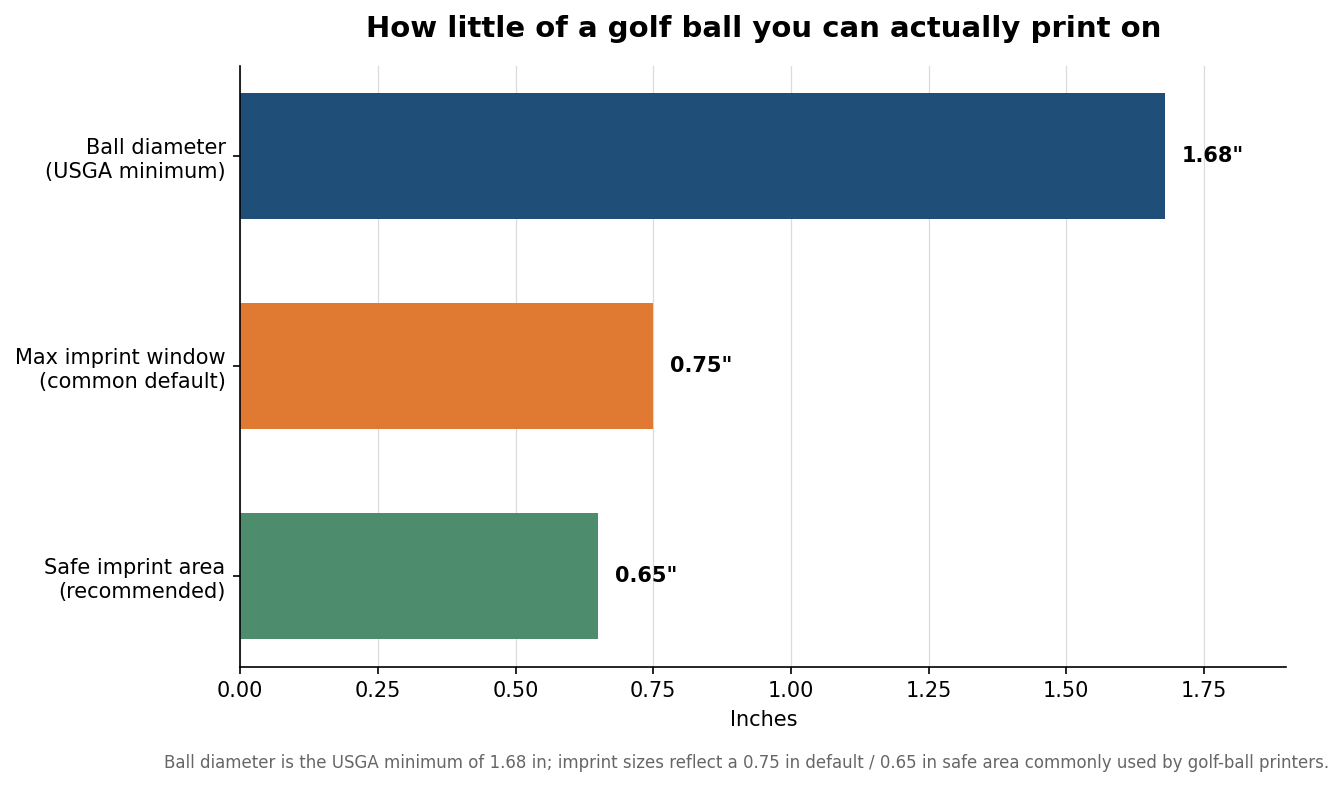
    Horizontal bar chart comparing a golf ball's 1.68-inch diameter to the 0.75-inch maximum imprint window and 0.65-inch safe print area
    A regulation ball is 1.68 inches across, but the usable print window is only about three-quarters of an inch.

    Send vector art first, high-resolution raster only as a fallback

    Because the print is tiny, every edge counts, and vector artwork is what keeps those edges crisp. A logo built as vector paths in a PDF, AI, or EPS file scales down to a golf ball without softening, and it lets the printer separate colors cleanly. If you only have a raster image, aim for at least 1,000 by 1,000 pixels on a transparent or clean white background, and expect the shop to charge a setup or art fee if they have to redraw it. Blurry source art cannot be sharpened after the fact; it can only be rebuilt.

    Watch line thickness above all. Hairline strokes and micro-text are the first things to fail on a curved surface, where a line that looks fine flat can break up or fill in once it wraps around the dimples. If your mark depends on very fine detail, thicken the lines slightly, or plan to drop the smallest elements entirely. Convert any text to outlines before sending so the printer does not need your exact font.

    Match colors to the print method

    Color is where the two common processes split. Pad printing lays down one to a few solid spot colors and is the workhorse for logos, because it repeats reliably on a dimpled sphere. It is ideal for one- and two-color marks, and printers generally ask for Pantone (PMS) numbers so the ink matches your brand rather than a screen approximation. What pad printing does not do well is blends: gradients, drop shadows, and photographic detail tend to band or muddy.

    When your artwork needs a gradient, a full-color image, or per-ball personalization such as individual names and numbers, UV digital printing is the method that handles it, because it images each ball rather than using a fixed plate. The tradeoff is that a design built for spot color often looks better and holds up better in pad printing, so it pays to decide the method before you finalize the art. The chart below shows the general fit; confirm the specifics with whoever is running your order.
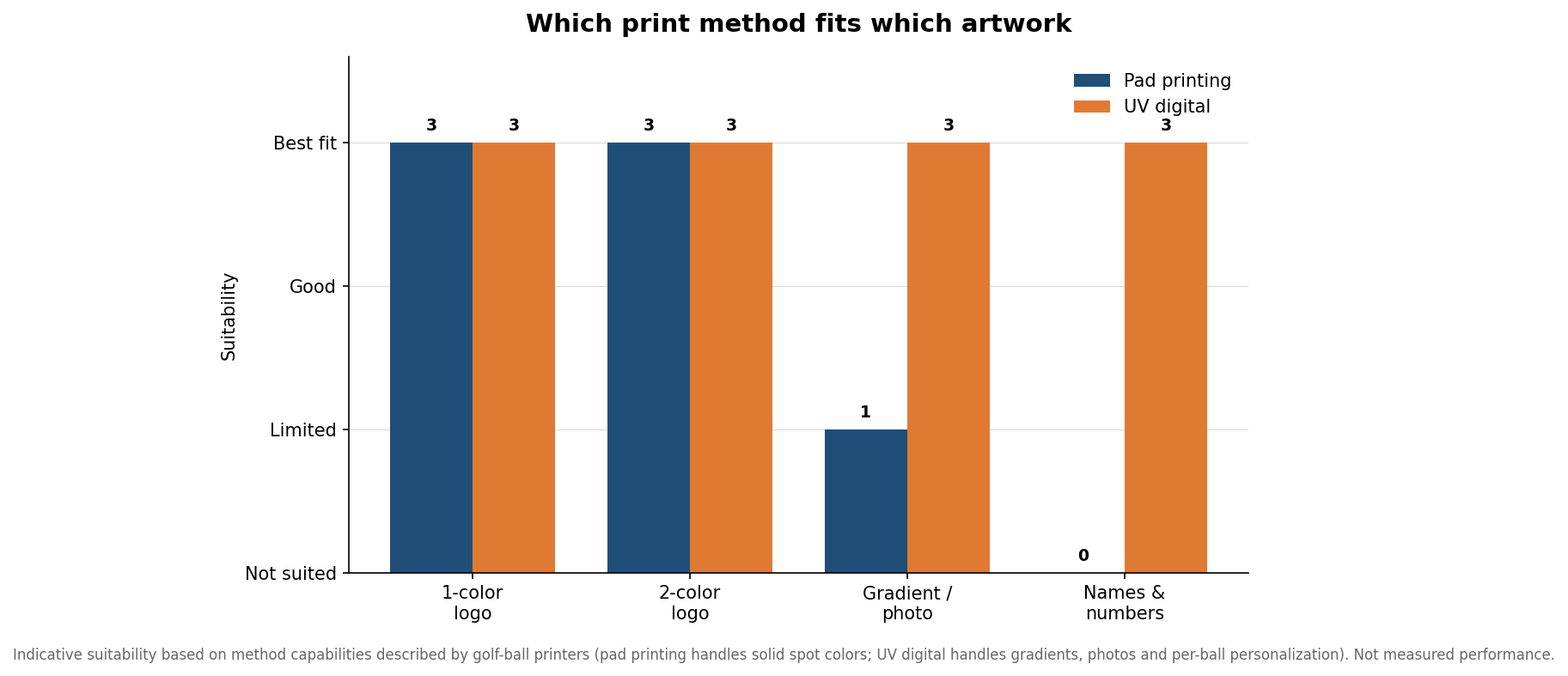
    Grouped bar chart showing pad printing suits solid one- and two-color logos while UV digital suits gradients, photos, and personalization
    Pad printing handles solid spot-color logos; UV digital is the method for gradients, photos, and per-ball names and numbers.

    Plan placement and personalization deliberately

    Most orders print a single logo on the side of the ball, positioned so it sits upright when the ball is teed with the alignment or brand stamp facing away. You can often add a second print location, a pole print, or a personalized line for a modest upcharge, but each added position is another setup and another chance for misalignment, so add them only when they earn their keep. For event balls, a small mark plus a date or foursome name reads better than trying to cram a logo and three lines of text into that 0.65-inch window.

    If you want every ball to carry a different name, say so up front, because that is a UV digital job, not a pad-printing one. Personalization at scale is straightforward on the right equipment and effectively impossible on the wrong one, and finding that out after you approve art is the expensive way to learn it.

    Proof it before you commit to a full run

    Two checks save the most money. First, approve a digital proof that shows your artwork sized and placed on the actual ball, and read it at real size, not zoomed in. Second, ask how the shop verifies that the ink actually bonds to the specific ball you ordered. Adhesion problems usually trace back to mold-release residue left on the cover rather than to the printing itself, which is why careful printers run a cross-hatch or tape-pull test on the exact model and finish before the full run, and some will send close-up macro photos of a printed sample so you can see the edges up close.

    Put simply, the printer needs three things from you: clean vector art built for a sub-inch window, your exact Pantone colors, and a clear call on method and placement. Bring those, approve a real-size proof, and confirm the adhesion check, and your custom golf balls will look the way they did in your head instead of the way a rushed file forced them to.
  • Are Your Custom Golf Balls Conforming? The USGA Rules Behind the Logo

    Are Your Custom Golf Balls Conforming? The USGA Rules Behind the Logo

    Printing a logo on a golf ball does not change whether it conforms to the Rules of Golf. Which ball you choose to print, however, decides everything. A custom order can put your mark on a fully tournament-legal ball a member will gladly play in a club championship, or on a practice ball that would disqualify that same member the moment it left the tee in a real competition. For most buyers the difference never comes up, but if your balls might be played competitively, or you simply want to sound credible when a golfer asks, it is worth understanding the handful of specifications that govern conformance and the rule change now on the horizon.

    The four hard limits

    Every conforming golf ball has to clear four numbers set by the USGA and the R&A, and manufacturers engineer right up to their edges. Weight may not exceed 1.620 ounces, or 45.93 grams, with no tolerance above that figure. Diameter must be at least 1.680 inches, or 42.67 millimeters; a ball can be larger, which is why a smaller ball is never legal but the standard is a floor rather than a target. Initial velocity is capped at 250 feet per second off the test apparatus, with a 2 percent tolerance that allows up to about 255. Finally, the Overall Distance Standard limits total distance, carry plus roll, to 317 yards under a defined laboratory test, with a 3-yard tolerance, so no conforming ball may travel more than 320 yards in that test. A fifth requirement, spherical symmetry, ensures the ball performs the same however it is oriented on the tee.

    The Conforming Golf Ball List

    You do not have to interpret those limits yourself. The USGA publishes a Conforming Golf Ball List, updated regularly, naming every make and model that has passed testing. When you order custom balls, the practical rule is simple: start from a model that appears on that list, and your printed version inherits its conforming status, because a surface logo applied by pad printing or UV digital printing does not alter the ball’s weight, size, or aerodynamics in any way that testing recognizes. This is why reputable custom programs build on brand-name models rather than unbranded stock of unknown origin. If a competitor might ever put your ball into play under the Rules, ordering a printed version of a listed model is the safeguard that matters.

    Practice, range, and non-conforming balls

    Plenty of custom golf balls are never meant to be conforming, and that is perfectly fine in the right setting. Range balls are built for durability and are typically limited-flight, novelty and floating balls exist for pools and lakes, and low-cost promotional balls may not appear on the conforming list at all. None of that is a problem for a driving-range bucket, a corporate giveaway, or a swag bag. It only becomes a problem in a competition played under the Rules of Golf, where using a non-conforming ball is a breach that carries disqualification. The one-ball and model rules used in elite events go further still by requiring a player to use the same brand and model throughout a round. So match the ball to its job: conforming, listed models for anything that might be scored, and whatever is most economical for practice and promotion.

    The 2028 rollback: what actually changes

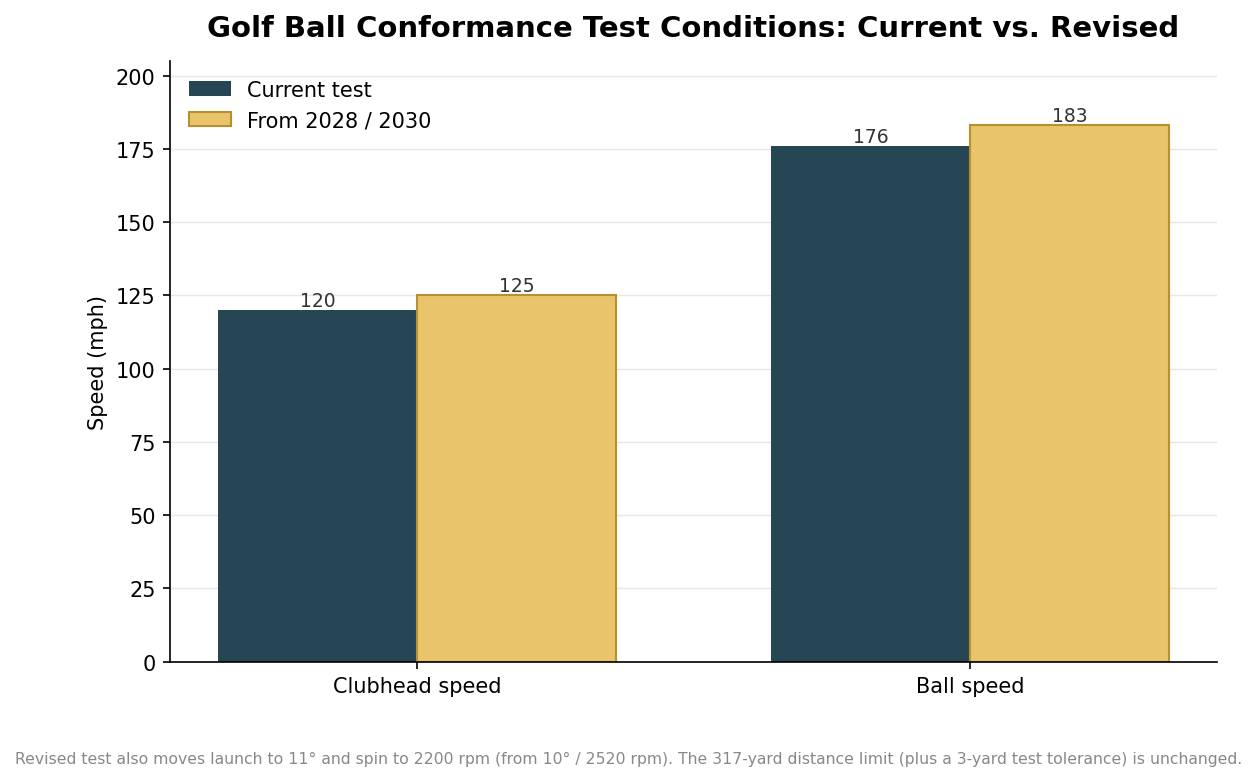
    In December 2023 the USGA and the R&A announced the first change to ball testing in years, and it takes effect in stages. The distance limit of 317 yards does not move. What changes is the test used to certify a ball against it. The current protocol swings the test club at 120 miles per hour, producing a 176 mile-per-hour ball speed at a 10-degree launch and 2,520 rpm of spin. The revised protocol raises that to 125 miles per hour and a 183 mile-per-hour ball speed, at an 11-degree launch and 2,200 rpm. Because the ball is now tested under harder conditions, some balls that pass today will exceed the limit and must be reformulated to stay conforming. The change applies to elite and professional competition from 2028 and to all golfers, including recreational play, from 2030.

    Grouped bar chart of current versus revised golf ball conformance test clubhead and ball speeds
    The revised test certifies balls under faster clubhead and ball speeds; the 317-yard limit is unchanged.

    How much distance is really at stake

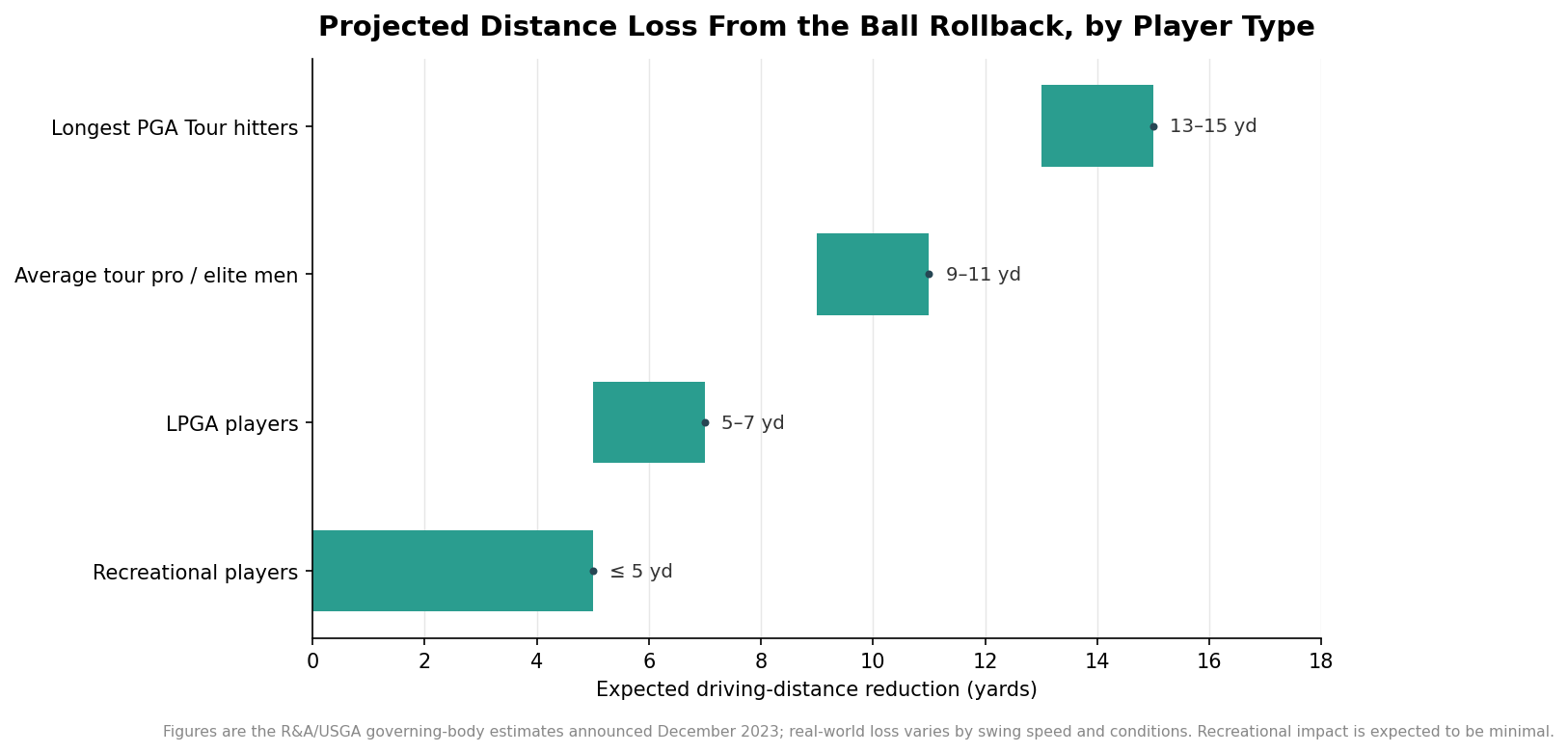
    The headlines make the rollback sound dramatic, but the governing bodies’ own projections put it in perspective. The longest hitters on the PGA Tour are expected to lose on the order of 13 to 15 yards off the driver, average tour professionals and elite male amateurs around 9 to 11, and LPGA players roughly 5 to 7. For the overwhelming majority of golfers, the recreational players who make up nearly every custom order, the projected loss is 5 yards or less per drive, and in day-to-day play most will never notice it. The rollback is aimed squarely at the top of the game, where distance had been climbing fastest, rather than at the weekend foursome.

    Horizontal range bars of projected driving distance loss from the golf ball rollback by player type
    Governing-body projections of driving-distance loss; recreational golfers are expected to lose 5 yards or less.

    What it means for an order today

    For anyone buying custom golf balls now, the takeaways are calm ones. Balls you purchase today remain conforming under the standard that applies to your players, and for recreational golfers that standard does not change until 2030. Premium tour models will be re-engineered by their makers to pass the new test well before their deadlines, and those updated models will simply appear on the conforming list in the normal way. If your order is for giveaways, gifts, outings, or practice, the rollback has essentially no bearing on your decision; if it is for a club that runs sanctioned competitions, keep specifying conforming, listed models and let the manufacturers handle the reformulation. As always, treat the figures here as the published rules and governing-body estimates rather than a substitute for checking the current Conforming Golf Ball List for the exact model you intend to print.

  • Which Golf Ball Should You Put Your Logo On? A Spec Comparison

    Which Golf Ball Should You Put Your Logo On? A Spec Comparison

    When you order custom golf balls in bulk, the logo is the easy decision. The harder one is which ball to print it on. A range ball, a soft two-piece, and a tour-level urethane ball all take a logo the same way, but they play so differently that the wrong choice can make an otherwise generous gift feel cheap, or make a giveaway cost three times what it needed to. This comparison lays out the specs that actually separate golf balls so you can match the ball to the people receiving it.

    The three tiers you are really choosing between

    Nearly every custom golf ball falls into one of three market tiers. Value and range balls are two-piece designs with a firm ionomer cover, built to be nearly indestructible and cheap by the bucket; they are the right call for driving-range stock, high-volume tournament handouts, and giveaways where quantity matters more than performance. Mid-tier balls add a softer core or a third layer and balance distance with a bit more feel, which makes them the popular choice for club logo balls and member gifts. Premium tour balls use three to five layers under a urethane cover to deliver the greenside spin and control that better players notice immediately; they are what you order when the recipient is a serious golfer or a sponsor you want to impress.

    Those three tiers also track price. The gap between a value ball and a tour ball at the same quantity can be several times over, so the tier decision drives your budget more than the imprint ever will.

    What compression does, and what it does not

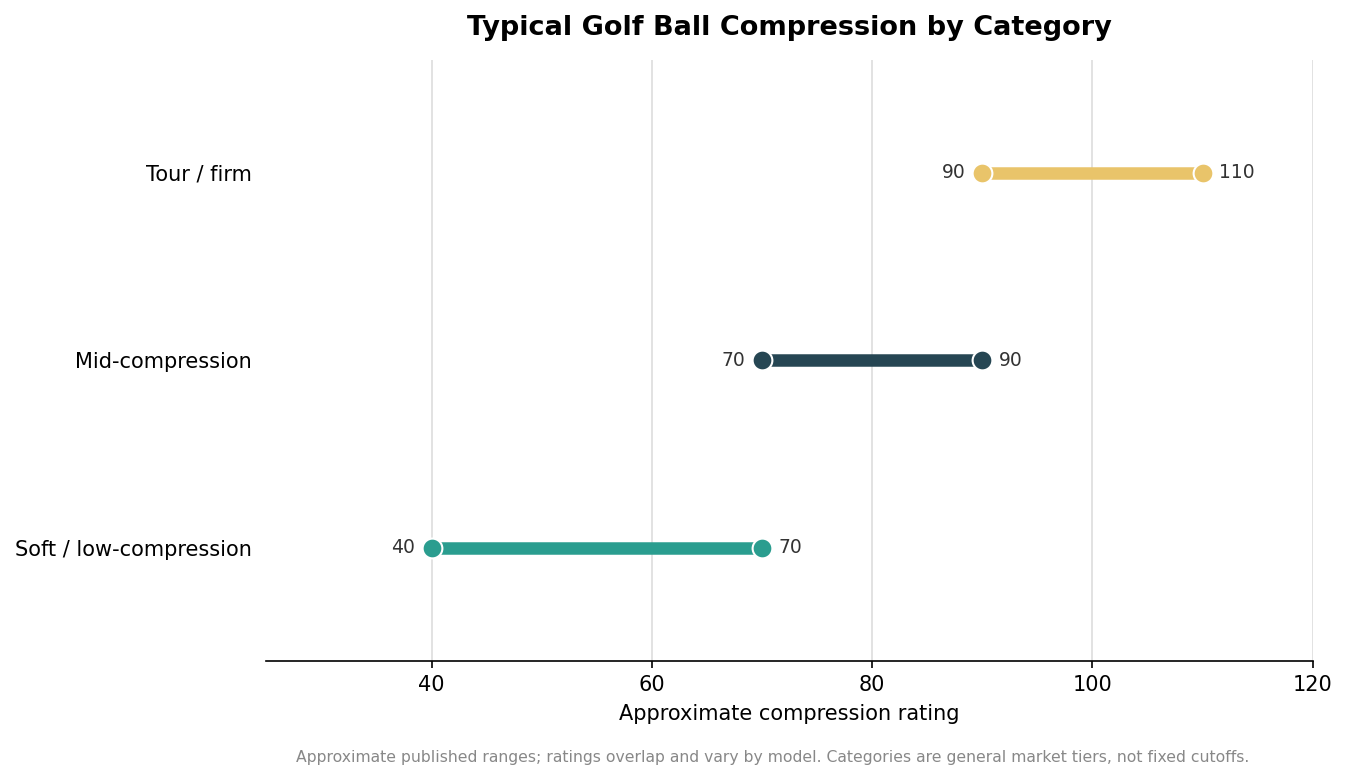
    Compression describes how much a ball deforms at impact, on a scale that runs from around 40 to well over 100. Soft, low-compression balls sit roughly in the 40 to 70 range, mid-compression balls in the 70 to 90 range, and firm tour balls at 90 and above. Lower compression generally feels softer and springs off the face more easily at slower swing speeds; higher compression feels firm and rewards faster, more aggressive swings.

    It is worth being honest about the limits of this number, because a lot of marketing overstates it. At moderate swing speeds the distance difference between a soft ball and a firm one is small, and the qualities golfers care about most, greenside spin and feel around the green, come more from the cover material and how the layers are stacked than from the compression rating alone. Treat compression as one useful sorting tool, not the whole story.

    Range chart of typical golf ball compression by category: soft 40 to 70, mid 70 to 90, and tour or firm 90 to 110
    Soft, mid, and tour balls occupy overlapping compression bands rather than fixed cutoffs.

    Cover and construction: where feel and spin come from

    The cover is the single biggest driver of on-course performance. Ionomer covers, often called Surlyn, are hard and cut-resistant; they produce lower spin, last a long time, and keep value balls affordable, which is exactly what you want for a ball that will get topped and skulled at a charity scramble. Urethane covers are softer and grip the grooves of a wedge, generating the greenside spin that lets a shot check up on the green. That spin is the result of stacking a soft cover over firmer inner layers, which is why premium balls carry three, four, or five pieces rather than two.

    For a bulk buyer, the practical takeaway is that construction and cover, not the logo, decide whether the ball feels like a premium gift or a range rock. A two-piece ionomer ball is the workhorse; a multilayer urethane ball is the statement piece. There is no wrong answer, only a right one for the audience.

    Match the ball to who receives it

    Start from the recipient and work backward to the spec. For range buckets, welcome-bag giveaways, and large outings where balls will be lost by the sleeve, a firm two-piece value ball is the sensible pick, and its higher compression barely matters when the goal is durability and volume. For club members and everyday players, a mid-compression ball offers a noticeably softer feel without the tour price. For sponsors, prize tables, and gifts aimed at low-handicap golfers, a soft urethane tour ball earns its cost because those players will feel the difference on every approach shot.

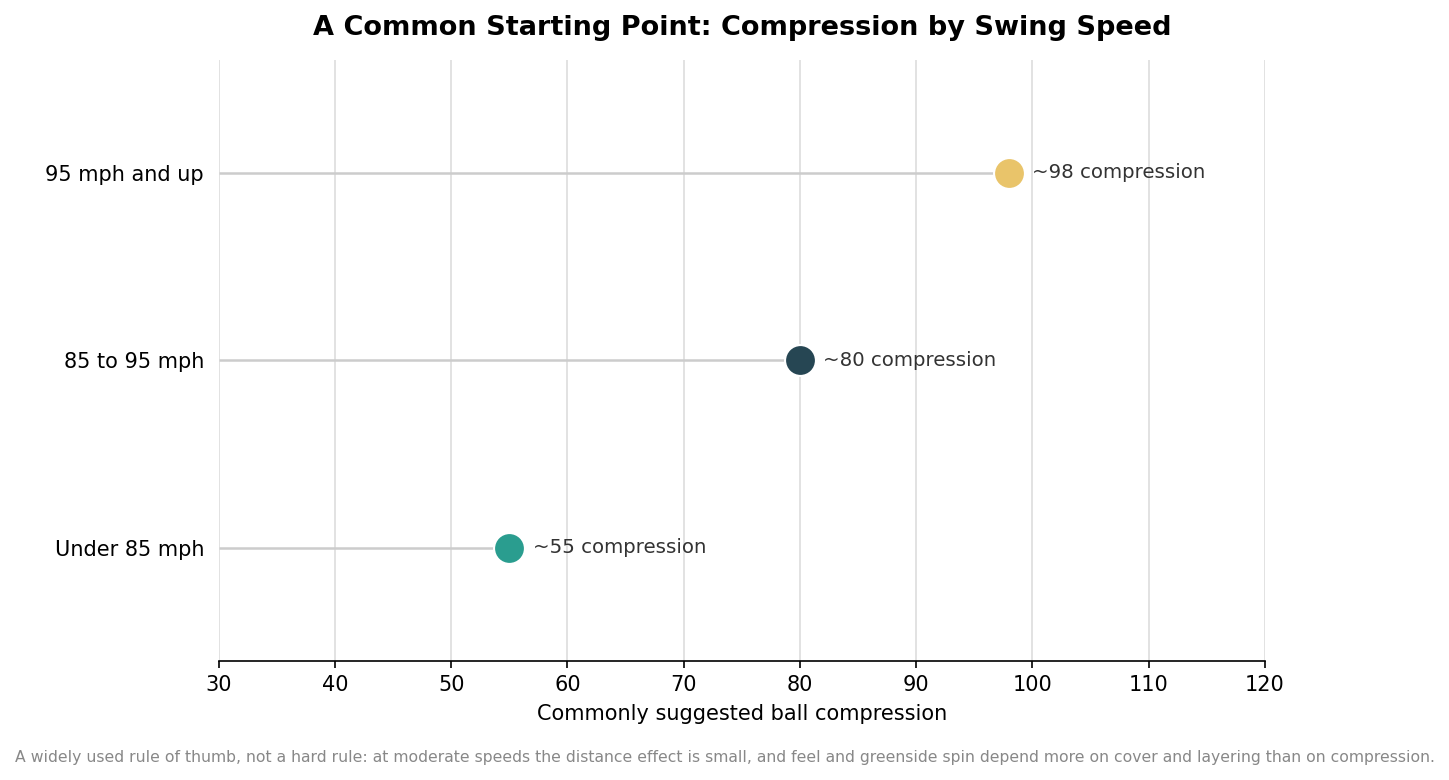
    Swing speed is a reasonable tiebreaker when you know your audience. The common guideline pairs slower swings with lower compression and faster swings with firmer balls, shown below. Use it as a starting point rather than a rule, since the real-world distance effect is modest for most golfers and personal feel preferences vary widely.

    Dot plot of commonly suggested golf ball compression by driver swing speed band: under 85 mph near 55, 85 to 95 mph near 80, and 95 mph and up near 98
    A widely used compression-by-swing-speed guideline, useful as a starting point, not a hard rule.

    Then confirm quantity, print, and lead time

    Quantity sets the unit price, and golf balls are almost always sold by the dozen. Custom logo runs typically price in tiers by the dozen or the case, and the per-ball cost drops as you move up in volume, so it pays to confirm the exact break points before you settle on a tier. Most logo balls are decorated by pad printing or UV digital printing, and a modern imprint holds up well through a round; a full-color design is easier on a lighter cover, so check that your artwork reproduces cleanly on the ball you chose. Finally, plan the calendar. Custom golf balls take about 2 weeks of production plus shipping at Get Custom Golf Balls, and demand spikes ahead of the summer tournament season, so order with a buffer and approve your proof promptly to protect the date.

    Packaging is the last lever, and it changes perception cheaply. The same ball reads very differently loose in a bucket, in a printed three-ball sleeve, or in a dozen box with a custom lid. For giveaways, a sleeve of three keeps handout costs down while still looking finished; for sponsor and prize gifts, a boxed dozen with a matching imprint turns a commodity into something recipients set on a shelf rather than tee up and lose. Decide packaging alongside the ball tier, not after, so the presentation matches the money you spent on the ball itself.

  • Tournament Gift Ideas Golfers Actually Keep

    Every tournament organizer has watched it happen: the field checks in, grabs the swag bag, and half of it never leaves the cart. If you are spending real budget on tee gifts, the goal is simple — give players something they will still be using in June. Here is what actually survives.

    The keep test

    A tee gift gets kept when it clears three bars: players use it during the round, it does not duplicate what they already own in quantity, and it does not feel like advertising first. Koozies and stress balls fail the third bar. A sleeve of balls with a well-printed event logo clears all three — every player needs balls, nobody has too many, and a good crest reads as a memento, not a billboard.

    What works, ranked by field size

    Small fields (up to 36 players)

    Go personal. Custom text balls with each player’s name are achievable at this size because digital printing lets wording change sleeve by sleeve. A member-guest that hands each pairing name-printed sleeves sets a tone no polo ever will.

    Mid fields (36–100 players)

    The event-logo sleeve is the standard for a reason: one design, packed by foursome, handed out at registration. Add prize dozens for flighted winners and marked balls for closest-to-the-pin, all in the same print order so everything matches.

    Large fields (100+ players)

    Double-position printing earns its keep — event logo on one pole, title sponsor on the other. Sponsors see their mark in every player’s hand, which makes next year’s sponsorship conversation noticeably easier. A sponsor proof sheet showing exactly what each tier gets helps the committee sell holes before the round.

    Timing and logistics

    Order once the field size is roughly known, not when registration closes — you can pad by ten percent. Standard production runs about two weeks, so a month of lead time is comfortable and leaves room for the proof round. Ask for packing by sleeve or foursome kit so registration morning is grab-and-go instead of an assembly line of volunteers.

    Stretching the budget

    If the budget covers only one printed item, make it the ball and let the bag, tees and towel stay generic. Players judge the gift table by its centerpiece. And keep a case of extra sleeves back for volunteers, sponsors and the inevitable last-minute foursome — the leftovers never go to waste, because someone on the committee will happily play them all season.

    The takeaway

    Spend where the use is: on the item every player tees up on the first hole. A well-printed ball turns your event into the thing golfers remember every time they reach into the bag — which is exactly what a tournament gift is for.

  • How Custom Golf Balls Are Printed: Pad Printing vs UV Digital

    Printing on a golf ball is a strange engineering problem: the surface is small, curved and covered in dimples, and the finished print has to survive being hit with a metal club at over 100 miles per hour. Two methods dominate — pad printing and UV digital printing — and knowing the difference helps you pick the right one for your order.

    Want the short version in a table? See our pad print vs. UV digital golf balls comparison.

    Pad printing: the tournament classic

    Pad printing has decorated golf balls for decades. A soft silicone pad picks up ink from an etched plate and presses it onto the pole of the ball. Because the pad deforms around the curve, the print lands evenly across the dimples.

    Its strengths are crisp spot colors and speed at volume. If your logo is one to four solid colors — most corporate marks are — pad printing reproduces them with sharp edges and exact color matching against your brand guide. It is the workhorse behind most course-logo and tournament balls you have ever teed up.

    UV digital: photos and unlimited color

    UV digital printing works more like a tiny inkjet: printheads lay down cyan, magenta, yellow and black droplets, and an ultraviolet lamp cures the ink solid the instant it lands. That instant cure is what lets a photograph, a gradient or a full-color crest sit cleanly on a dimpled surface without bleeding.

    Digital is the method behind photo golf balls, multi-color wedding monograms and any design with shading or fine detail. It also makes short runs and per-sleeve personalization practical — every dozen in an order can carry different wording without new plates.

    Which should you choose?

    Choose pad printing when…

    Your artwork is a solid-color logo, you care about exact spot-color matching, and the order is a straightforward run of one design — a club crest, a company mark, an event logo.

    Choose UV digital when…

    The design uses photos, gradients or many colors; you want different wording across the order; or the artwork has fine detail that plates would blur. Photo balls, wedding scripts and full-color mascots all live here.

    What both methods share

    Either way, the ink is cured to the cover and clear-protected, so a proper print survives ball washers, wedges, bunker sand and water hazards. Both keep the ball USGA-conforming — printing does not change size, weight or flight. And both start the same way at a good printer: a free digital mockup showing your artwork at true scale on the dimple pattern, approved by you before anything prints.

    The bottom line

    You usually do not have to decide alone — send your artwork and quantity, and the print team will recommend the method that suits the design. From 12 balls for a foursome gift to pallets for a member-guest, the right method is the one that makes your logo look inevitable on the tee.

  • The Complete Buyer’s Guide to Custom Logo Golf Balls

    Ordering custom logo golf balls for the first time raises the same handful of questions for almost every buyer — a tournament chair, an office manager, a pro-shop owner. This guide answers them in the order they usually come up.

    1. Which ball is under the logo?

    Most custom orders print on a two-piece distance ball with a Surlyn cover: mid-compression, forgiving for average swing speeds, durable enough for cart paths and ball washers, and USGA-conforming so it is legal in your scramble or league. The cover takes ink cleanly, which is why it is the industry standard for logo work. If your group plays premium urethane balls, ask — but for gifts, giveaways and events, the two-piece is the right call for almost everyone.

    2. What artwork do you need?

    A vector file (AI, EPS, PDF, SVG) is ideal because it scales cleanly to the small print area. Only have a JPG or PNG from an email signature? A good supplier redraws it free. The print area is a circle of roughly 22 millimeters — about the size of a quarter — so simple, bold marks read best. Very fine taglines and thin serifs can disappear at that size; your proof will show exactly how the mark holds up.

    3. Single or double position?

    Single-position printing puts your logo on one pole of the ball. Double-position prints both poles — either the same logo twice, so it shows however the ball lands, or two different marks, which is how tournaments fit an event logo on one side and a sponsor on the other.

    4. How does the proof process work?

    Nothing should ever print without your sign-off. Expect a free digital mockup within about 24 hours showing position, scale and colors on the dimple pattern, with unlimited revisions until it is right. Color-critical brands should say so up front — spot colors get matched against your brand guide, not eyeballed.

    5. How long does it take?

    Standard production and delivery run about two weeks from proof approval, with express options when a shotgun start will not move. The practical advice: order as soon as your date is set, and tell your supplier the event date so production is planned backwards from it.

    6. How many should you order?

    The math most planners use: one sleeve of three per player as a tee gift, plus dozens for prizes and contests. A 144-player scramble is typically 48–60 dozen. Gifting clients? A dozen per top account, sleeves for the wider list. Minimums start at just 12 balls, so you can also order small — a personalized foursome gift — without committing to event volume.

    The short version

    Pick the standard two-piece ball, send whatever artwork you have, approve the 24-hour mockup, and give yourself two weeks. Do those four things and custom golf balls are one of the easiest — and most-kept — branded items you will ever order.