Printing a logo on a golf ball does not change whether it conforms to the Rules of Golf. Which ball you choose to print, however, decides everything. A custom order can put your mark on a fully tournament-legal ball a member will gladly play in a club championship, or on a practice ball that would disqualify that same member the moment it left the tee in a real competition. For most buyers the difference never comes up, but if your balls might be played competitively, or you simply want to sound credible when a golfer asks, it is worth understanding the handful of specifications that govern conformance and the rule change now on the horizon.
The four hard limits
Every conforming golf ball has to clear four numbers set by the USGA and the R&A, and manufacturers engineer right up to their edges. Weight may not exceed 1.620 ounces, or 45.93 grams, with no tolerance above that figure. Diameter must be at least 1.680 inches, or 42.67 millimeters; a ball can be larger, which is why a smaller ball is never legal but the standard is a floor rather than a target. Initial velocity is capped at 250 feet per second off the test apparatus, with a 2 percent tolerance that allows up to about 255. Finally, the Overall Distance Standard limits total distance, carry plus roll, to 317 yards under a defined laboratory test, with a 3-yard tolerance, so no conforming ball may travel more than 320 yards in that test. A fifth requirement, spherical symmetry, ensures the ball performs the same however it is oriented on the tee.
The Conforming Golf Ball List
You do not have to interpret those limits yourself. The USGA publishes a Conforming Golf Ball List, updated regularly, naming every make and model that has passed testing. When you order custom balls, the practical rule is simple: start from a model that appears on that list, and your printed version inherits its conforming status, because a surface logo applied by pad printing or UV digital printing does not alter the ball’s weight, size, or aerodynamics in any way that testing recognizes. This is why reputable custom programs build on brand-name models rather than unbranded stock of unknown origin. If a competitor might ever put your ball into play under the Rules, ordering a printed version of a listed model is the safeguard that matters.
Practice, range, and non-conforming balls
Plenty of custom golf balls are never meant to be conforming, and that is perfectly fine in the right setting. Range balls are built for durability and are typically limited-flight, novelty and floating balls exist for pools and lakes, and low-cost promotional balls may not appear on the conforming list at all. None of that is a problem for a driving-range bucket, a corporate giveaway, or a swag bag. It only becomes a problem in a competition played under the Rules of Golf, where using a non-conforming ball is a breach that carries disqualification. The one-ball and model rules used in elite events go further still by requiring a player to use the same brand and model throughout a round. So match the ball to its job: conforming, listed models for anything that might be scored, and whatever is most economical for practice and promotion.
The 2028 rollback: what actually changes
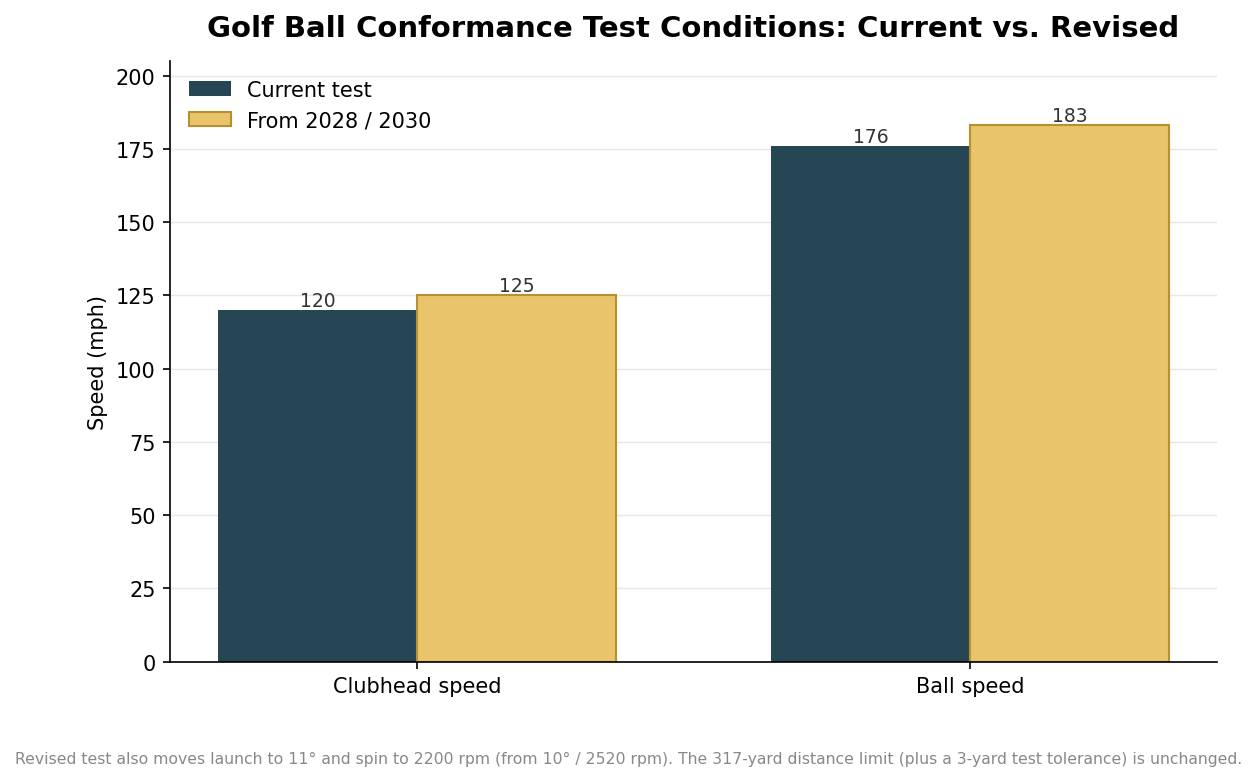
In December 2023 the USGA and the R&A announced the first change to ball testing in years, and it takes effect in stages. The distance limit of 317 yards does not move. What changes is the test used to certify a ball against it. The current protocol swings the test club at 120 miles per hour, producing a 176 mile-per-hour ball speed at a 10-degree launch and 2,520 rpm of spin. The revised protocol raises that to 125 miles per hour and a 183 mile-per-hour ball speed, at an 11-degree launch and 2,200 rpm. Because the ball is now tested under harder conditions, some balls that pass today will exceed the limit and must be reformulated to stay conforming. The change applies to elite and professional competition from 2028 and to all golfers, including recreational play, from 2030.
How much distance is really at stake
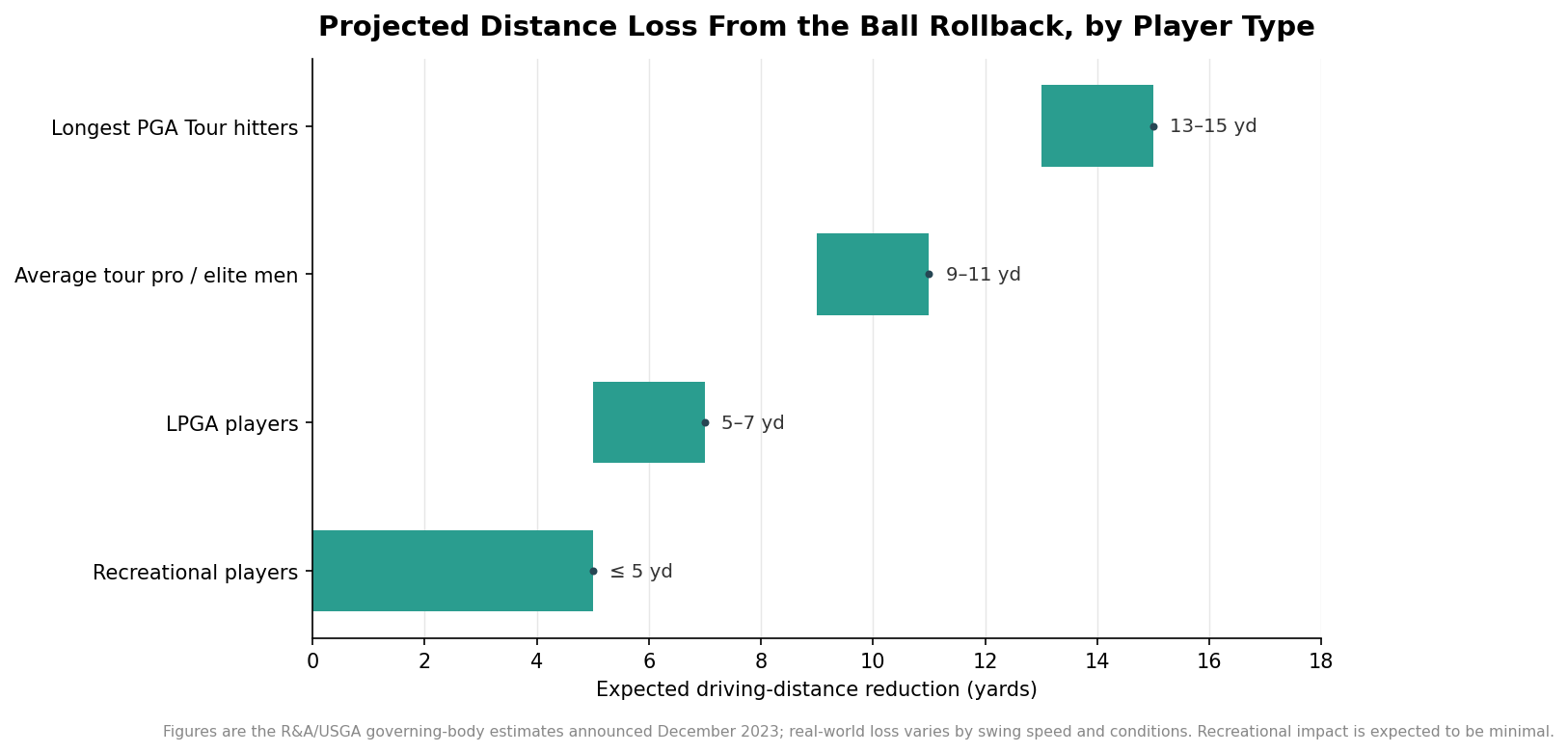
The headlines make the rollback sound dramatic, but the governing bodies’ own projections put it in perspective. The longest hitters on the PGA Tour are expected to lose on the order of 13 to 15 yards off the driver, average tour professionals and elite male amateurs around 9 to 11, and LPGA players roughly 5 to 7. For the overwhelming majority of golfers, the recreational players who make up nearly every custom order, the projected loss is 5 yards or less per drive, and in day-to-day play most will never notice it. The rollback is aimed squarely at the top of the game, where distance had been climbing fastest, rather than at the weekend foursome.
What it means for an order today
For anyone buying custom golf balls now, the takeaways are calm ones. Balls you purchase today remain conforming under the standard that applies to your players, and for recreational golfers that standard does not change until 2030. Premium tour models will be re-engineered by their makers to pass the new test well before their deadlines, and those updated models will simply appear on the conforming list in the normal way. If your order is for giveaways, gifts, outings, or practice, the rollback has essentially no bearing on your decision; if it is for a club that runs sanctioned competitions, keep specifying conforming, listed models and let the manufacturers handle the reformulation. As always, treat the figures here as the published rules and governing-body estimates rather than a substitute for checking the current Conforming Golf Ball List for the exact model you intend to print.